Like many sports, climbing has a language all of its own. Here is a glossary of general climbing terms for you to become more familiar with:
- Anchors – usually two bolts at the top of a climb (sometimes one, sometimes none.. it really depends)
- Approach – hike from your starting point to the base of the climb or climbing area
- ATC – A device used to belay your climbing partner. It allows you to safely stop them if they were to fall, and lets you rappel.
- Belay -A way to control the falls or descent of your climbing partner by controlling the speed of the rope which they are attached to (essentially secures your climbing partner to the rope to ensure their safety when climbing.)
- Beta – like insider information. Can be used for route description about the crux moves, or approach, etc. (really, just more in-depth information)
- Bouldering – Climbing without a rope. Usually there is a crash pad under the climber to help assist in safe falls. (Also, it is pretty dang hard – completely different climbing scale than sport or trad. It involves hard, short problems (bouldering term for route) that require a lot of strength)
- Crag – climbing area with a number of routes on one wall
- Crash pad – a padded mat used in bouldering to offer a better landing and protection than than ground
- Crux – hardest part of the climb
- Figure 8 – a type of knot that connects your harness to the rope – it is very strong and prevents the rope from detaching from the climber (when tied properly- should always be checked by your climbing partner!).
- Grading scale – in the United States the grading scale is based upon the Yosemite Decimal System. It is a three part system that grades difficulty levels of walks, hikes and climbs. Technical climbing is considered Class 5. All climbing routes start with “5._” , the number following the decimal rates the difficulty of the climb. A 0 would be the easiest. When climbing first came around, it was unheard of to see any climbs above 5.10, but now it goes up to 5.15!
- Guidebook – well, it is what the name implies – a book that serves as a guide to an area (however, climbers are notoriously bad at drawing topo’s and describing approaches so take the information with a grain of salt)
- Harness – hopefully this is more self-explanatory, but it is what a climber wears around their waist/legs for safety (when properly tied into the rope) and it also holds gear on loops that project from the waist.
- MountainProject – a website dedicated to climbing areas (the guidebook of all guidebooks)
- Pitch – roughly one rope’s length. It can be single – you go to the top and come back down on one rope. Or multiple (“multi-pitch”) – where once you complete one, you continue up the wall, rather than descending to the ground. Multi-pitch either involves rappelling back to the ground or hiking off from the summit of the climb – depends on each climb.
- Quick-draw – two carabiners attached by webbing.
- Rappel – A way to descend off the mountain (usually referred to as “rap” or “rapping-off”)
- Rope – I hope you know what a rope is.
- Sport climbing – A type of climbing that developed in order to climb routes that could not be protected by crack systems (however, there are some cases where there are sport routes that involve cracks, but I won’t get into the ethics of that!). Rather than relying on gear placed by the climber, there are bolts in the rock that allow the climber to climb a carabiner and then the rope.
- Topo’s – a topographical map (can be hand drawn or a picture of the rock) that shows where the route is located. Essentially a map of your route that is oriented vertically instead of horizontally like a typical map. This map shows which features to follow, where belay stations should be located, and should contain descent info for multi-pitch climbs.
- Traditional climbing (“trad”) – The original type of climbing (ie, “traditional”). It involves placing gear (nuts, camelots, tri-cams, etc.) on the route to ensure safety. The person following the climb will remove the pieces as they go. Generally considered a more natural way to climb- with preserving the original nature of the rock.
- Tyrolean – a way to traverse across some void to get to there other side.
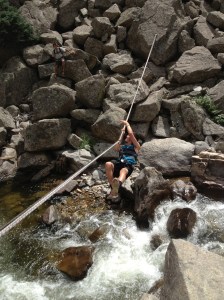
My cousin, Ian using a tyrolean above Boulder Creek
 Paige Ashley